

Pets, now part of the modern Taiwanese family

As I arrived at the Chan Chao Taipei Pets Show at the Nangang Exhibition Center, confronted by the parade of pet strollers swerving through the exhibitor’s stands, I was taken back to a moment during my first few weeks in Taiwan.
I was walking down Yongkang Street in Central Taipei and glanced down at a passing stroller expecting the returned smile of a toddler, only to be growled at by an indignant, yappy Chihuahua.
As I have spent more time in Taipei, I have come to learn that this was not an illusion, or strange nightmare, but rather a growing and very real phenomenon in this country.

An article from Newsweek last week confirmed that Taiwan’s population of pet cats and dogs was 3.2 million, compared to 2.68 million children aged 14 and under.
Pet ownership has steadily grown in recent years as the next generation of Taiwanese are opting for pets over children, and the elderly are looking for companions to care for. Factors such as cost of living pressures, demands placed upon parents for their children to succeed from a young age, the global trend of an individualistic mindset, and even the unique position Taiwan finds itself geo-politically, all contribute to this trend.
This trend has lead to booming growth in Taiwan’s pet food industry, now the fifth largest market in Asia, and this was very evident at the Chan Chao Taipei Pets Show 2026.
With well over 300 exhibitors across two levels. It served as an excellent opportunity to get a sense of the market, which companies, both domestic and international, are operating here, and what consumers are looking for in their products.

It was great to see a New Zealand presence on display. There were established New Zealand brands adorned with the ‘New Zealand Made’ certification such as Ziwi, K9, Zeal, Rawternative, Absolute Holistic, and Addiction, along with international brands that were using New Zealand raw ingredients and then processing and packaging for the Taiwan market.
From both the vendor and consumer perspective, New Zealand’s product is the benchmark in terms of quality. New Zealand brands are highly trusted in the market, with a reputation built on a safe regulatory environment for the high standard production of meat and fish products. Our pet food brands are seen as being as 'natural' as possible, with many being free of any added chemicals or additives, and containing very high nutritional value.

It is because of this reputation that New Zealand products are able to demand a higher price. In the case of Ziwi and K9, these products were at times two or three times the price of the equivalent sized bag of other pet food brands that I saw. My immediate reaction was to assume that many New Zealand brands were therefore priced out of the market, however consumers and company representatives alike confirmed that the price was not the determining factor.
Across all income groups, consumer preferences are being driven by emotion, the willingness to pay for quality to ensure that their loved one is getting the best quality nutrition and standard of living as possible.
New Zealand exporters of pet food rightly do not need me to tell them something that they already know. However, along with the excellent brands we have on offer and the strong position that ‘New Zealand Made’ holds in the market, I feel it would also be worthwhile to consider some of the challenges that may become more relevant in the future.
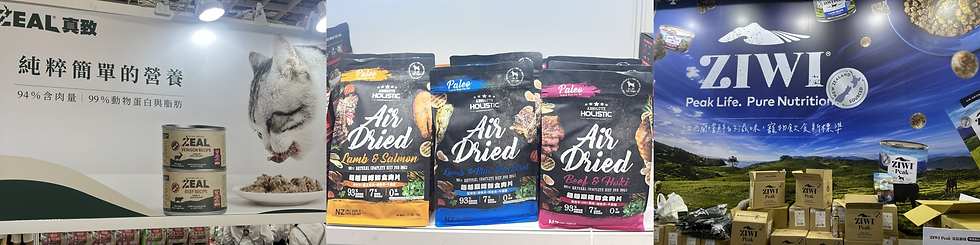
What struck me most about the exhibition was the shear variety of products now available to the consumer. Well-established brands such as Royal Canin of France, American company Hills Pet Nutrition, several dozen Canadian products, along with products from Thailand, Great Britain, Germany, Italy, Korea and Japan, all jostling for shelf space. I had a sense that the scale of investment was significant, and that there was huge competition for these companies to be at the forefront of consumers’ minds to grab a bigger piece of the pie.
Speaking with a distributor of a Korean-brand, it was interesting to hear her thoughts on recent trends. She said that the younger generation were now more willing to give other products a go and were not always sticking to the same ‘established’ brands. The new wave of consumers also seem to be more value conscious and are demanding functionality, convenience along with the nutritional benefits.

Brands are pushing their certifications and nutritional information, have onstage promotors listing off the benefits and are giving away free products. Brands are trying new forms of packaging, trying to cater for a convenience-driven, younger consumer, particularly those that own a smaller dog.
It also seems to be the case that demand for freeze-dried and air-dried pet food has really taken off. Speaking with one New Zealand distributor, the benefit of freeze-dried products is that it skips the high-heat processing used for kibble, and therefore retains more nutrients, flavours and enzymes. Pets obviously prefer these products and so it was clear that all brands were keen to get this product type out the consumer.
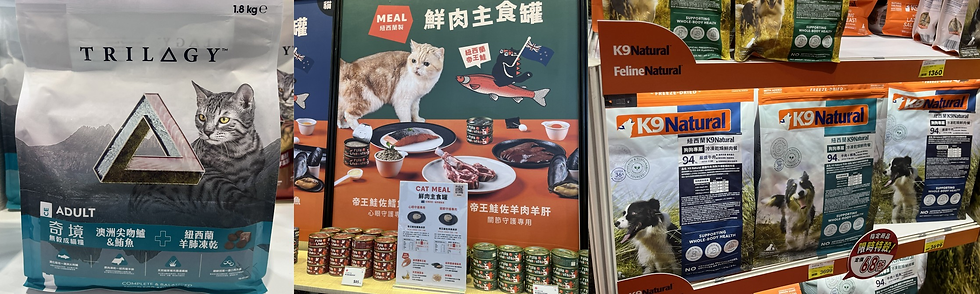
From what I know of the Taiwanese consumer across industries, they have a willingness to pay a higher price if the quality is there, and they are also willing to try something new. This puts New Zealand brands in a brilliant position to capitalise on the next stage of growth of the pet food category, and it is a sector that is by no means slowing down.
In the same breath, it is possible that the competitive moat that our brands are currently enjoying will continue to shrink as other countries and their brands have improved their products, standardising their production and certification, and investing heavily in marketing strategies to improve their image.
It calls for New Zealand companies to be more engaged with the market, working more closely with New Zealand Trade and Enterprise and their local partners. I think this is an excellent opportunity to build on the existing success achieved and to be more innovative in the sector to ensure that New Zealand pet food brands remain the benchmark and market leader in the sector.
About the Author
Based in Taipei, Tom Durkin is a Huayu Enrichment Scholar studying at National Taiwan Normal University - Mandarin Training Center. He has several years’ experience in financial markets, holding a Bachelor of Arts and Commerce in Economics and International Business from the University of Otago.
Tom has been part of two Asia New Zealand Foundation Leadership Network delegations to both Taiwan and China. His role as Market Analyst for the New Zealand Taiwan Business Council is to undertake research of related sectors and trends on the ground in Taiwan, with the hope that the research can benefit New Zealand companies and organisation wishing to do business with Taiwan.
Comments